
Data and AI
Kyndryl and Skillsoft expand AI education access to help high school students build future-ready skills
Press release
29-Sept-2026

Hackers hijacked a Spanish newspaper’s website, plastering its front page with a ransom demand and the word “PWNED” in neon green. As time ticked by, the crisis team scrambled over urgent choices: pay up, shut systems down, or face customers with bad news.
Thankfully, this was just a simulation. Twenty-two students from Colegio San Viator, a primary and secondary school in Madrid, were putting their cybersecurity skills to the test at Kyndryl’s Security Operations Center (SOC), one of the company’s six global cyberthreat monitoring facilities.
The event was the first of three site visits organized recently by the Kyndryl Foundation in Madrid, Barrie, Ontario and New York, for students from communities that have been traditionally underrepresented in tech.
As an IT services company with a people‑first culture, Kyndryl puts community skilling at the center of its impact strategy. The company launched the Kyndryl Foundation — its nonprofit arm that funds programs to build digital skills and expand access to technology careers worldwide — within two years of becoming an independent company. Backed by global expertise, Kyndryl Foundation was created to help equip people with digital skills for today and tomorrow, and its programs meet the specific needs of communities in which the company operates.
Kyndryl and Kyndryl Foundation are both committed to increasing the reach and impact of training in areas where skills are needed, like cybersecurity.
All three hands-on events share one objective: equipping more young people with skills for a digital future. “They told us not to worry about getting the ‘right’ answer,” says Lucas Medrano, a student participant from Fundación Cibervoluntarios, a Kyndryl Foundation grantee. “There wasn’t a correct solution — we were there to learn and enjoy the process.” These immersive, on-site experiences were designed to inspire young people to envision themselves in meaningful careers in technology.
“With Kyndryl’s expertise, we can foster these opportunities all over the world, and more people can thrive in the digital economy,” says Monoswita Saha, Social Impact Director, Kyndryl. With 68% of organizations worldwide reporting a cybersecurity workforce shortage, Saha says it makes sense to cast a wider net: “A more resilient talent ecosystem helps companies stay competitive.”
The students touring the Madrid facility were drawn in by the opportunity to ask questions and participate in the same type of cyberattack simulation that Kyndryl conducts with executive-level customers. The students had already learned about encryption, codebreaking and vulnerability detection from Fundación Cibervoluntarios. Being at the center of the action helped sell them on cybersecurity as a career.
“I’ve always been drawn to technology,” says Elena Rodríguez, a Colegio San Viator student. “Seeing everything from the inside made that interest stronger.”
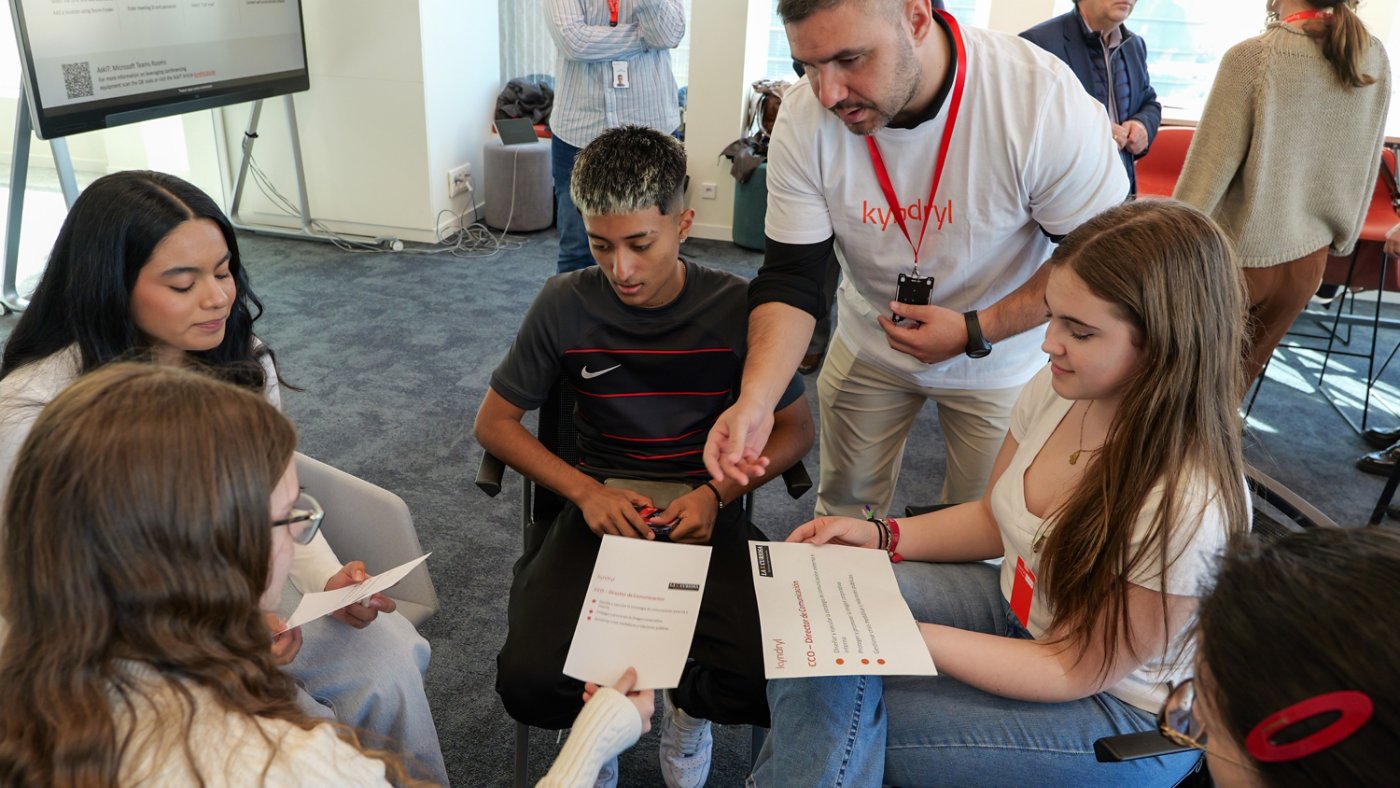
"I’ve always been drawn to technology. Seeing everything from the inside made that interest stronger.”
Elena Rodríguez, Student, Colegio San Viator
This year, Kyndryl’s Security Operations Center in Barrie, Ontario, welcomed students from the Joint Economic Development Initiative (JEDI), a Kyndryl Foundation grantee that provides workforce training to Indigenous communities in New Brunswick.
The Kyndryl visit offered a preview of day-to-day life on the front lines of cyber defense: round-the-clock threat monitoring and triage; analysis of new criminal techniques; and the dissection of attack software in the malware lab. After showing students what the cloud really looks like — a live data center with rows of high-performance servers — senior leaders fielded questions about everything from emerging opportunities to their own experiences on the job.
The students discovered a role model in Denis Villeneuve, Kyndryl’s cybersecurity and resilience practice leader in Canada, and himself a member of the Peter Ballantyne Cree Nation. “You can’t be what you can’t see,” he said. “For many students, this was their first time seeing technology at this scale. When that happens, cybersecurity stops being abstract and starts to feel like a career they can actually pursue.”
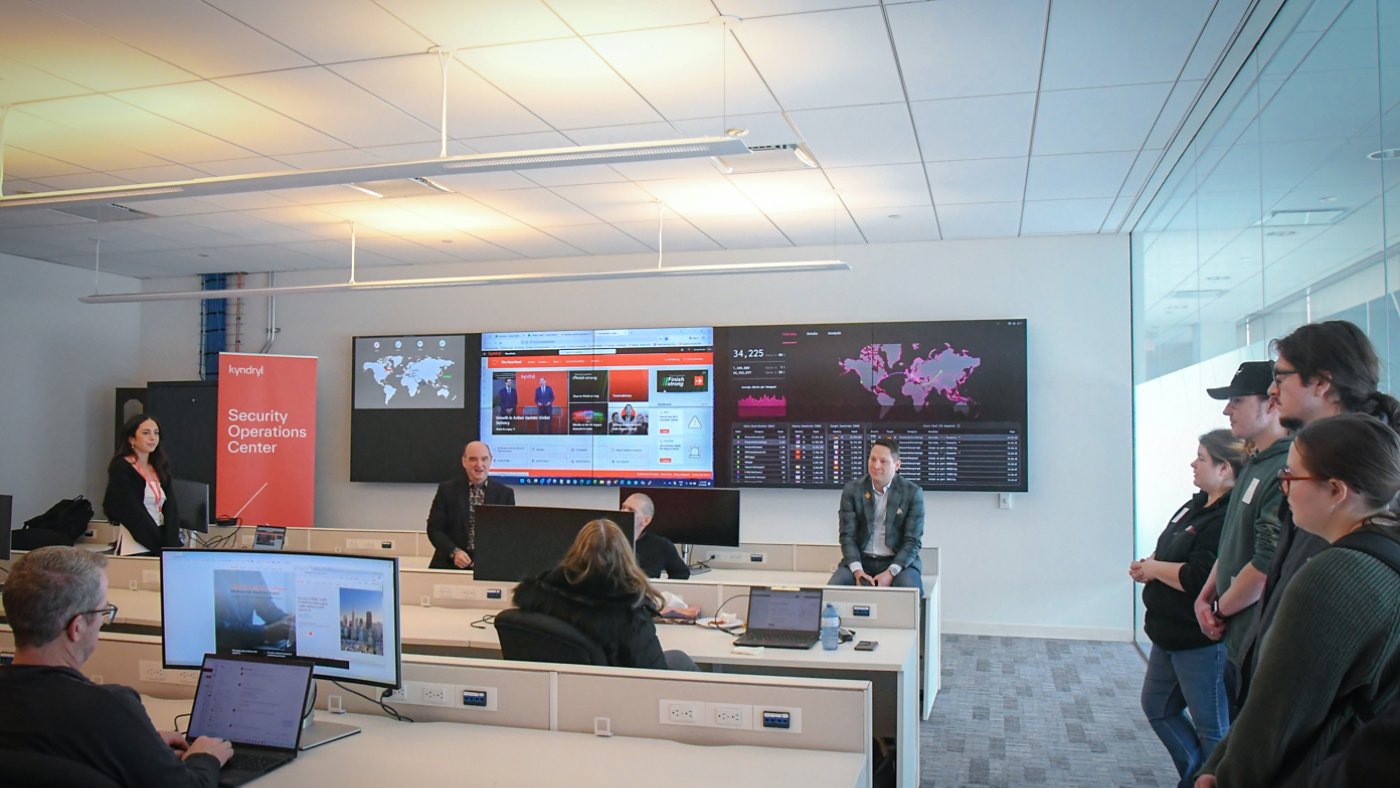
“You can’t be what you can’t see. For many students, this was their first time seeing technology at this scale."
Denis Villeneuve, Cybersecurity and Resilience Practice Leader, Kyndryl Canada
On a cloudy day in late March, for the fourth year in a row, Kyndryl’s global headquarters in Manhattan opened its doors to sophomores from Brooklyn’s Academy of Innovative Technology (AoIT) as part of Career Discovery Week.
“There’s nothing like watching young people light up as they begin to imagine what a career in technology — and any future career — could look like,” says Pam Hacker, Vice President, Social Impact at Kyndryl.
To introduce students to a broad range of IT industry professions, Kyndryl co-hosted the event with the MetLife Foundation. Participants broke into small groups to discuss — and demystify — career paths. Volunteers recounted their work experiences stretching back to high school, looking into the past to help students chart the way forward.
“The students can see themselves in a different light,” says Meagan Ramsawak, a teacher at AoIT. “They can visualize themselves having those opportunities and being in those spaces.” The day’s activities culminated in a professional communication skills workshop, where mentors helped each student craft a two-minute elevator pitch. About a third of the students volunteered to deliver their pitches to the attendees.
“Listening to the pitches is amazing,” Saha says. “The students start the day shy and not knowing what to expect. By the time they pitch, they have so much confidence. It’s lovely to see the transformation.”
Keyshonte Bornia, an AoIT student, told Hacker before he left for the day: “You’re going to see me here in the future. I can’t wait to fill those shoes.”
Across Madrid, Barrie and New York, one idea holds true: when young people see what’s possible, they begin to believe it’s within reach. From simulated cyberattacks to real-world mentorship, these experiences do more than teach — they transform. By expanding access, building skills and strengthening confidence, Kyndryl is helping shape a more inclusive, resilient future workforce.
"It felt good, because I saw their backgrounds. They came from the bottom,” said Sheadan Layne, a sophomore at AoIT. “If they can do it, so can I.”

