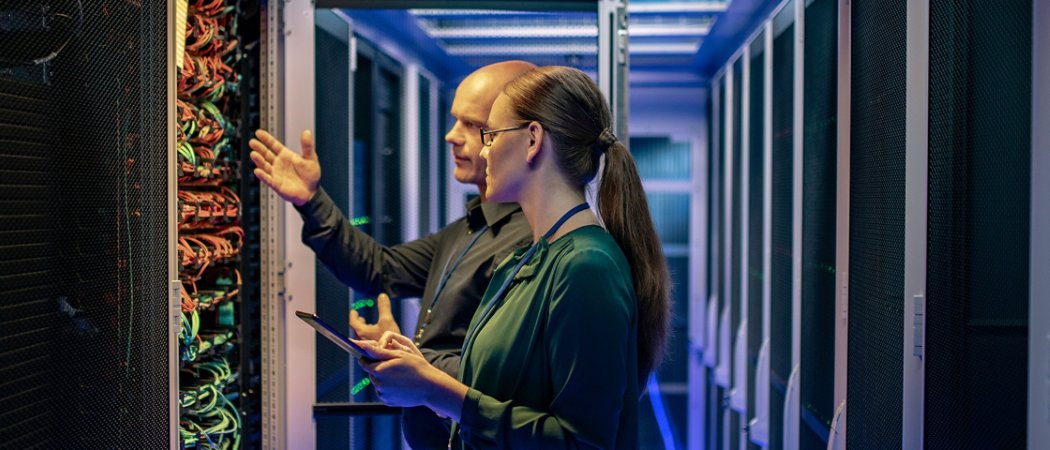
Black IT technician employs neural networks and pattern recognition for a software to drive transformation and improve decision making, with big data deep learning systems for optimization.
AI

How AI PCs change the stakes for transforming enterprise architecture

Aug 7, 2026 Read time: 1 min

By Dennis Perpetua and Jimi Lin

An underappreciated element of the AI revolution is poised to transform enterprise computing: Specialized neural processing units (NPUs) embedded in AI PCs enable them to directly participate in AI processing. NPUs make local inference at scale possible and introduce a new architectural layer inside the enterprise.

As the endpoint again becomes a dedicated compute tier, NPUs will fundamentally change how enterprises design AI systems and how workers interact with computers. This will happen quickly as enterprise leaders start to understand AI PCs’ profound benefits. Already, 81% of organizations are using AI PCs or planning to adopt them within a year, according to IDC. There’s good reason that AI PCs were a star of the 2026 Consumer Electronics Show.

We expect that NPUs will begin to influence enterprise architecture decisions by 2027 and that almost every employee’s laptop will include an NPU by 2029. By the end of this decade, it will be difficult to justify enterprise architectures that ignore local AI capabilities altogether. Enterprise leaders will benefit from recognizing the inevitability of the shift to hybrid edge AI enabled by AI PCs and from working swiftly to integrate these devices into their architecture.

letter-Q-thin-everett-cloud2

How do AI PCs change enterprise architecture?

Most organizations today operate with two primary compute tiers:

  1. Centralized cloud and SaaS platforms
  2. Client devices that consume them

AI PCs introduce meaningful inference and agentic capability directly at the client endpoint. Large language models and training workloads remain in the cloud, where centralization makes sense, while AI PCs handle distributed, task-specific models that benefit from speed, privacy or contextual awareness. Applications increasingly decide which tasks remain local and which are sent to the cloud.

The hybrid edge AI setup can increase speed, affordability and sustainability. Running models locally on an AI PC allows inference tasks to complete dramatically faster, more quietly, more affordably and with less resource use than their cloud-based equivalents. Enterprises can define new baselines for the performance, privacy, cost and energy efficiency of AI workloads.

Hybrid edge AI also provides enterprises more choice about where AI workloads belong. Instead of running models on either public cloud or on‑prem infrastructure, organizations can choose among multiple permutations of public models, local models and—increasingly—AI PC models using the devices employees already employ every day.

While testing AI PCs, we observed a clear performance and efficiency shift when running inference locally versus in the cloud. In one experiment conducted on Dell Pro AI PCs powered by Intel Core Ultra Processors, a locally run model delivered ~10x faster response times than the same query executed via cloud AI services, while achieving about 70% lower energy consumption and eliminating network dependency entirely. In our view, Dell platforms powered by Intel are well suited to hybrid edge AI use cases because they can distribute workloads across CPU, GPU, NPU and cloud resources.

This advanced functionality illustrates how hybrid edge AI allows enterprises to redefine baselines for performance, cost, privacy and sustainability by placing the right workloads at the endpoint while reserving the cloud for large-scale training and orchestration. Also, running AI inference locally reduces reliance on cloud‑based token consumption. When tasks are handled directly on the device, organizations avoid repeated API calls, network overhead and per‑use inference costs, thereby lowering operational spend while improving responsiveness.

Another advantage of hybrid edge AI is the potential for more secure handling of sensitive information. Running models and agents locally allows enterprises to process proprietary data or personally identifiable information without sending it to external systems. However, the shift to hybrid edge AI will require enterprises to find ways to distribute approved models to endpoints, apply updates consistently, enforce data masking and usage controls, and ensure security and policy compliance across thousands of devices. Governance of hybrid AI is going to demand more sophisticated observability controls than are needed for today’s agentic frameworks focused on cloud-based workloads. In a hybrid edge AI environment, governance does not move to the edge but extends to it.


letter-Q-thin-everett-spruce

What platform choices bring hybrid edge AI to life?

The enterprise value of AI PCs depends on selecting platforms that can be deployed consistently across roles, locations and refresh cycles.

AI endpoints must be governed like enterprise infrastructure, not consumer accessories. Fleet manageability, hardware-assisted security, BIOS and firmware protections, identity safeguards, application compatibility, and lifecycle services all become part of the AI architecture. In this sense, the endpoint becomes both a productivity device and a governed AI execution environment.

The CPU remains essential for application logic and foreground responsiveness, the GPU accelerates parallel and media-rich workloads, and the NPU is optimized for sustained, low-power AI inference such as summarization, transcription, background effects, semantic search and local agents. That division of labor is what makes hybrid edge AI practical (and, notably, it’s inherent to how the Dell portfolio powered by Intel has been designed). Models can run close to the employee when latency, privacy, cost or connectivity matter, while larger orchestration and training workloads remain in cloud and data-center environments.

letter-Q-thin-everett-cloud2

How do AI PCs enable high-trust environments?

A powerful yet less frequently discussed implication of local AI inference is the ability to operate in disconnected or intentionally isolated environments. Not every system can—or should—assume always-on connectivity. For example, government systems, defense environments and other sensitive workloads often operate on networks intentionally disconnected from the internet. In these contexts, cloud‑based AI is either impractical or prohibited.

For such organizations, the ability to run capable AI locally opens new opportunities, as AI can operate wherever work is done, regardless of connectivity. By enabling capable AI inference locally, AI PCs allow organizations to deploy intelligent workflows in air‑gapped environments, supporting analysis, decision assistance and automation without exposing sensitive data or relying on external connectivity.

letter-Q-thin-everett-spruce

How do AI PCs function as self-healing devices?

NPUs also introduce an opportunity to transform endpoints from managed assets into self-maintaining systems. With local inference, a device seeded with the right model can continuously assess its own state and correct in real time.

Instead of waiting for an issue to surface, the system can predict and prevent problems before the employee ever notices. Further, new AI tools enable device management even when the operating system is unavailable or the device is outside the corporate network.

letter-Q-thin-everett-cloud2

How do AI PCs improve employee experience?

The self-healing capability of AI PCs enables a better user experience for employees: fewer technical problems, less need for IT support and reduced downtime while solving issues.

Hybrid edge AI also opens the door to a more privacy-conscious approach to employee management, trading potentially intrusive behavior monitoring for modeling of each job’s requirements for tools and resources. The system supports the employee without requiring the tracking of their activities, an important distinction for both privacy and trust.

letter-Q-thin-everett-spruce

How will AI PCs reshape the digital workplace?

Over time, AI PCs will encourage smarter distribution of workloads across CPUs, GPUs, NPUs and cloud platforms. The enterprise architecture that emerges from this will include cloud platforms, SaaS systems and a growing layer of intelligent edge devices. That third layer will move more business processes closer to where the work happens.

This change will introduce new security considerations and operational challenges, but it will also open the door for heightened creativity in enterprise computing. Designers and developers will have the opportunity to harness distributed AI capabilities in ways that reshape the digital workplace for generations to come.

Over the next one to two years, the true bellwether for AI PCs will not be hardware adoption alone but architectural design and decision‑making. As NPUs become standard in employee devices, enterprises will begin designing systems that deliberately distribute workloads across cloud platforms, infrastructure and endpoints. This transition mirrors earlier shifts, such as multi-core processing, in which the real impact emerged only after architects and developers rethought how systems were designed.

AI PCs signal that moment has arrived again.

Dennis Perpetua is Global CTO of Digital Workplace Services at Kyndryl. Jimi Lin is a Customer Enterprise Architect at Kyndryl.