
Building the intelligent bank
How Agentic AI is transforming experiences, payments and security

With AI agents entering the finance sector and regulatory pressure easing, Kyndryl Financial Services experts scan the horizon for banking’s transformations to come.
Article co-created by Bloomberg Media Studios and Kyndryl
As with virtually every industry, banking is falling under the spell of AI. A 2025 analysis by Bloomberg Intelligence points to potential profitability gains of more than 12%—totaling $100 billion—as banks ramp up their reliance on AI.
By deploying AI agents, banks could realize even more than the 5% productivity lift expected from generative AI over the next three to five years, according to Bloomberg.
But while the maxim that “every company is now a technology company” takes on special significance in the age of AI, financial institutions must be even more strategic and intentional before they blaze forward with automation, says Neha Arora, Vice President and Consult Partner, Financial Services at Kyndryl.
As banks heed the imperative to operate like digital natives, AI implementation has a very different weight in banking, she says.
That’s because banks not only must stay current on their technology systems—they also face intense regulation, compliance scrutiny and heightened sensitivities around data and customer trust—all while, in many cases, making patchwork upgrades to legacy infrastructure.
Still, it’s important to understand that the regulatory burden will not slow AI. Instead, it will engineer the next wave of competitiveness.

“For banks, being a technology company does not mean just adopting AI. It means embedding trust, compliance and resilience into every layer of the tech stack.”
Neha Arora
Vice President and Consult Partner, Financial Services
Kyndryl
Assessing banking readiness for AI
Bloomberg’s analysis of AI in the banking sector was based on a survey of 93 leaders at banks around the world, including legacy institutions and neobanks.
And while AI use in banking already exceeds analyst expectations, the path to full adoption and agentic autonomy could take more than five years because of the sector’s unique regulatory environment, the Bloomberg survey found.
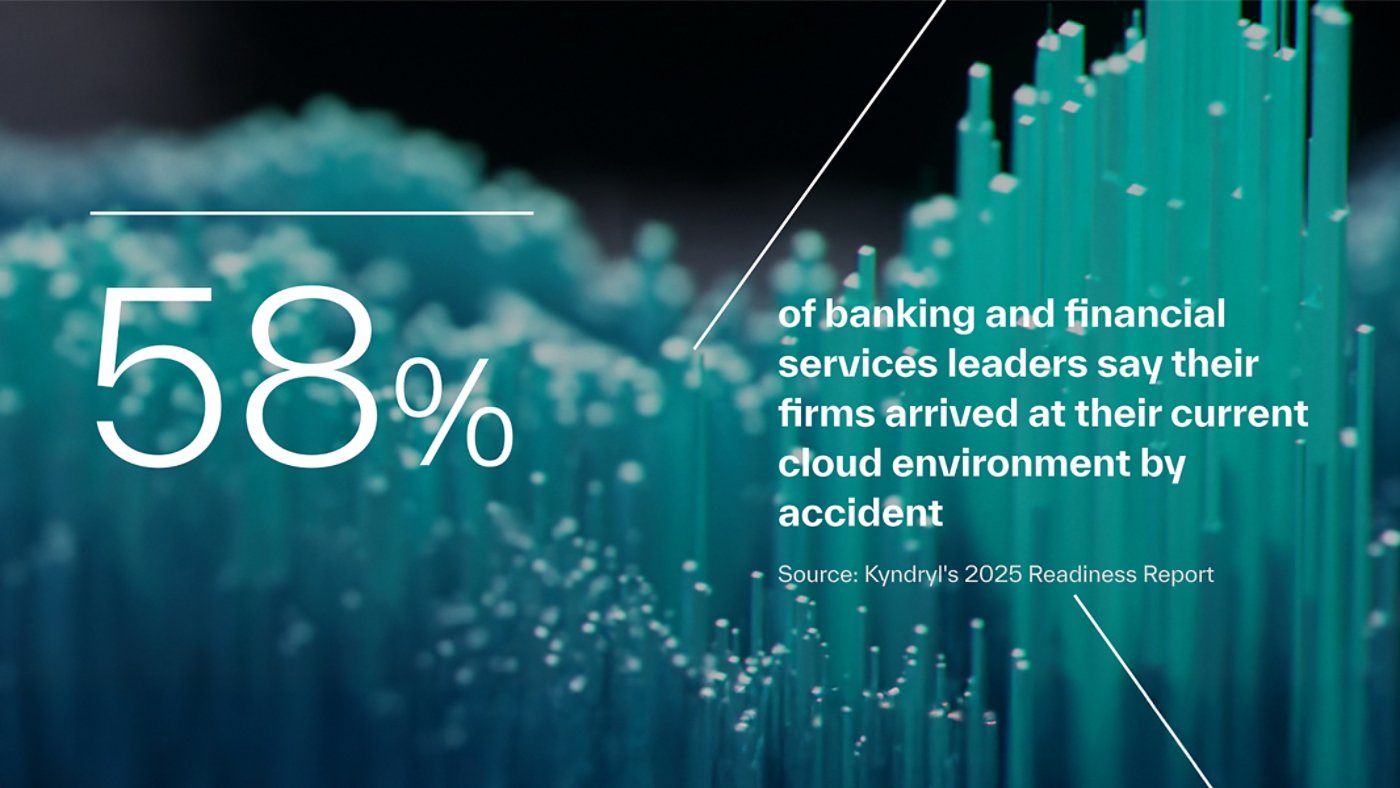
Banking’s legacy infrastructure also presents a barrier to widespread AI adoption. More than a quarter of banking and financial services sector leaders surveyed for Kyndryl’s 2025 Readiness Report say their operating systems, servers and networks are at or near their end-of-service mark, and 58% said they arrived at their current cloud environment “by accident,” rather than as a result of a proactive strategy.
Still, there are bright spots. 54% of survey respondents across industries report that their investments in AI and machine learning are already showing ROI.
And, says Arora, there are opportunities in the challenges.
One is prioritizing an API-first system—a sector trend that creates discrete, defined products rather than integrations that must be absorbed into other systems. Modular and interoperable by design, API products help banks and fintech firms focus on the fast, reliable services that customers expect.
“Everybody needs to take baby steps,” says Arora. “An API focus allows banks to integrate AI without massive big-bang transformation.”
She sees this dynamic as especially advantageous to smaller banks, which tend to be free of the entrenched legacy systems that can slow AI integration for larger players.
“There’s more agility there,” notes Arora.
Anju Tiwari, Vice President and Consult Partner, Financial Services at Kyndryl, observes AI adoption moving more swiftly in the middle tier of banking. Neither too small to scale AI applications, nor too large to face the data hurdles of a legacy system, the middle segment is positioned to move faster.
“If you talk to the larger banks that are taking on neobanks, they want to skip being the digital bank and go straight to being the intelligent bank,” Tiwari says.
Customer experience intelligence
The next AI-powered step change for banking will be adding a layer to the customer experience that Arora and Tiwari describe as “invisible embedded finance”: intuitive products and apps that present themselves within users’ financial routines at the moments that will provide maximum value.
In addition, on top of automation in fraud detection and credit scoring, banks will increasingly rely on AI for intelligent payment orchestration.
Arora cites the customer-experience precedents of Apple Pay, Google Pay and PayPal earning trust in the payments space outside of the context of traditional banking. By seamlessly embedding themselves in consumer buying behaviors, these tech companies put pressure on banks to step up their digital game, Arora says.
“That paves the way for them to adopt AI as a competitive differentiator,” she says.
AI can assess cost, speed and risk to choose an optimal payment rail, whether it’s an automated clearing house (ACH), a card network or the blockchain. This helps reduce operational costs for banks while delivering fewer failed transactions and a better customer experience.
Arora also foresees the mainstreaming of AI applications that scan a bank customer’s location and spending patterns across a given timeframe, empowering the system to suggest relevant offers or financing options at the time of purchase. This enhanced degree of personalization—backed by transparency and established trust—highlights AI’s power to go beyond efficiency to deepen customer relationships.
“This will be a great game changer for the banks,” Arora says.
At the end of the day, customers don’t just want faster banking. They want banking that is supportive, fair and explainable—backed by trust and transparency.
Recommended content
How does your AI strategy stack up?
Assess your AI readiness

Fostering trust in agentic decisions
More and more of the processes that determine both the speed and supportiveness of banking will be turned over to AI agents, mirroring the larger trend of agentic acceleration.
As Bloomberg has reported, earnings-call mentions of AI agents saw a 4x increase in the fourth quarter of 2024 compared to the previous quarter, signaling their rapidly growing importance within enterprise AI strategies.
Patrick Gormley, Global Data Science and AI Consult Lead at Kyndryl, acknowledges that the AI agent market is noisy at the moment, and says he’s seeing large companies attempt to establish their AI bona fides by citing the thousands of agents that they’ve built.
But, says Gormley, what they should be doing is building fewer agents that are more capable and executable.

“Customers don’t want to buy agents. Customers want to buy outcomes.”
Patrick Gormley
Global Data Science and AI Consult Lead
Kyndryl
Arora observes many banking clients leveraging AI to cut costs, and she forecasts a coming strategic shift not only in security—using AI tools to fight AI-powered threats—but also in the customer experience.
Soon, for example, AI agents will take on the work of evaluating loan applications and rendering decisions. And while Arora and Tiwari agree that speed matters less than transparency, agentic AI’s ability to streamline processes is a win for both sides of the desk—banker and customer alike.
Decisions or resolutions that once took more than an hour to reach can be made in under 20 minutes via agents, Tiwari points out.
This requires accurate customer profiles, clearly documented credit bureau data transaction history and employment and income details.
“What will set a loan-review AI agent up for success is a strong data foundation,” says Arora.
Then, whatever the decision, the rationale must be clear and equitable, citing traditional, provable factors like debt-to-income ratio.
Otherwise, Arora counsels, customers may automatically reject any unfavorable decision that they know or suspect was generated by an AI agent rather than by a human banker.

Regulators pivot from AI barriers to AI enablers
From the Wyoming Blockchain Symposium this past summer, Bloomberg’s Banking Industry Monitor newsletter reported that Michelle Bowman, Vice Chair for Supervision of the Federal Reserve’s Board of Governors, cautioned banks that they risked losing relevance in the economy if they didn’t ease rules governing AI and crypto in their sector. This was one of the strongest signals yet that even regulators are recognizing not just the inevitability, but the opportunity that AI presents.
This advice conforms to what Arora and Tiwari are hearing from Kyndryl’s financial clients as they balance emerging tech and compliance.
The good news, Arora says, is that investing in a transparent AI governance system can turn regulatory pressure into a competitive edge.
Regulators overseeing AI are—unsurprisingly—not supportive of opaque black-box governance models, Tiwali says.
Tiwali says that Kyndryl creates peace of mind and a clear way forward for clients by helping them understand shifting regulator expectations, and establishing clear audit-trail transparency when evaluations and decisioning are being conducted by AI. Embedding transparency into how models are aligned to regulatory frameworks, including how models are trained, helps instill regulator confidence as well.
“If they are confident that the model is complying with regulatory requirements, including training to achieve the decisions, they can accept it,” Tiwari says.

“Regulators know they can’t be a barrier to AI. They must be an enabler.”
Anju Tiwari
Vice President and Consult Partner, Financial Services
Kyndryl
Banking’s delicate balance
Bloomberg reporting on the intersection of AI and banking affirms that the technology is engineering banking-customer loyalty to a hyperspecific degree, including developing models to predict when a customer might be considering moving their money elsewhere so that the bank can intervene and preserve the relationship.
Arora understands the nuances between customer expectation and banking’s back-end realities.
“Everybody wants loan approvals faster, and always-on support that’s only achievable through chatbots and virtual assistants,” she says. “They don’t want lags, but they also want trustworthiness.
“How banks establish that balance will define what the future of AI in banking turns out to be.”
Discover additional insights about the future of intelligent banking here