

How to kickstart the modernization conversation
Article co-created by Bloomberg Media Studios and Kyndryl
The years-long debate about AI’s potential returns may be coming to an end, especially as agentic implementations have begun to transform modern work. When CEOs can demonstrate how AI is embedded in their businesses with appropriate governance and security tooling in place, their corporate earnings improve, Bloomberg reports; one company saw a 45% increase in share gains after detailing its AI use cases on earnings calls.
But for most organizations, becoming an AI-native enterprise—with AI integrated across technologies, processes and the workforce—requires broad modernizations. A recent Kyndryl study of business readiness for AI adoption revealed that 72% of organizations report having more technology pilots than they can realistically scale, and 57% say AI innovation is delayed due to foundational issues in their technology stack.
This AI-readiness gap reveals two truths: First, leaders understand that moving beyond pilots to scale AI across the entire organization is the only way to drive real value and long-term business outcomes; and second, the ability to scale is inhibited by technology environments that aren’t equipped to support growth.
Why traditional modernization approaches fail
Shawn D’Souza, SVP, Global Modernization Leader at Kyndryl, asserts that many enterprise technology environments were built piecemeal to meet evolving market demands and emerging regulatory requirements, resulting in complex, multigenerational stacks spanning mainframes, cloud and on-premise systems. Operational silos are built in, and each system operates with its own tools, policies and budgets.
“Traditional modernization approaches add new complexity to already complex environments,” says D’Souza. “Projects that span years not only create operational instability that increases vulnerability but also fail to deliver meaningful outcomes because the business, the market and the competitive landscape have changed.”
How AI is changing the modernization conversation
To scale agentic AI, modernization needs to happen fast, with less risk, according to D’Souza. With the pace of change accelerated by AI, one day’s optimization can become next week’s legacy. AI becomes both an enabler for faster modernization and a desired outcome of those efforts.
Initiatives that lay the foundation for properly governed and secure-by-design agentic AI can compress implementation timelines from six months or more to weeks. But speed alone isn’t enough. Agents create measurable value when they have context into how systems behave under load, over time and across the processes they support. That context enables AI to manage data, extract rules, generate architectures and automate tests with human supervision for decisions that affect mission-critical operations.
Agents don't take breaks, which means they continuously analyze an organization's ecosystem, D'Souza says. Agents will scan for new patterns to enact the incremental, continuous improvement that turns modernization into maintenance.

“Modernization must become continuous and incremental to minimize risk and improve outcomes.”
Shawn D’Souza | SVP, Global Modernization Leader | Kyndryl
Before devising a roadmap for continuous modernization, CTOs and CIOs may need to make the case to their peers that it’s worth pursuing, especially if previous modernization efforts fell short of generating value.
“Successful integration of AI at scale is also about culture,” D’Souza says. “It’s about how you shift the operating model. It’s about how to re-skill people. It’s about asking, ‘What are the incentives to adopt this technology?’”
D’Souza places today’s AI urgency—and opportunity—in the context of two inflection points:
The time for wait-and-see is over. Even leaders once inclined to treat AI as overhyped now understand that they’ll be left behind without an AI strategy. Today, the clock has run out on AI over-caution.
“There’s enough pressure from the business to modernize systems because the cans have already been kicked down the road for years,” says D’Souza. “Now, we’re at the point where delaying modernization is getting in the way of business reinvention.”
Incremental change is not only possible, but preferable. With the right culture in place, modernization can be more self-sustaining than during the pre-cloud days of invasive upgrades, where the entire organization was upended.
“Previously, you might have had to go to the board, secure a big budget and fight ‘failure fatigue,’” D’Souza says. “Now, you can make modernization part of your DNA—just keeping it up as part of the muscle to run the organization. This ‘always ready’ environment will be what sets leaders apart as new technologies emerge.”
Creating your modernization checklist
While each business has unique needs, D’Souza maintains that today, almost every company faces a necessary evolution of its approach.
“You have to fundamentally shift your architecture—the application logic, the data and the infrastructure below that to make AI deliver value at scale,” D’Souza says. “You’re talking about a different type of architecture: feedback loops, planners, execution of workflows. So, traditional thinking no longer applies.”
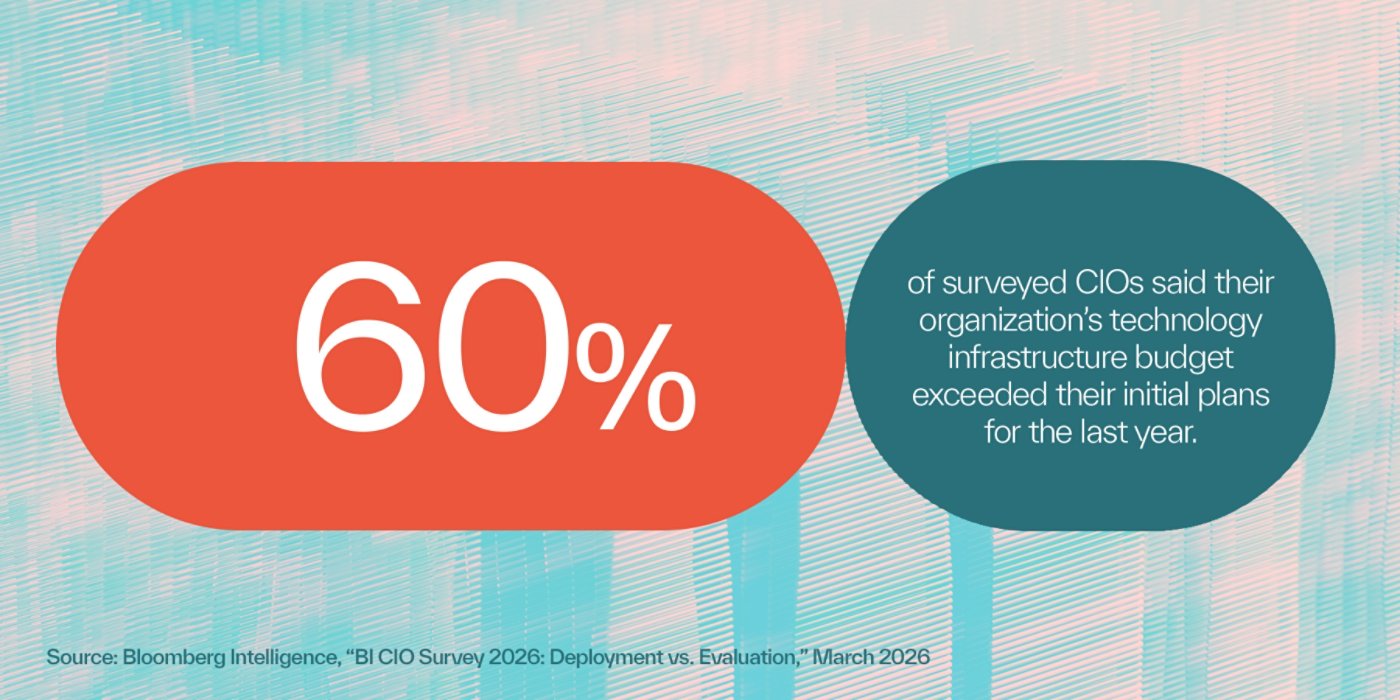
Once CTOs and CIOs have helped company leadership understand the moment, they can establish the momentum for modernization. This process should begin with an enterprise-wide audit to map exposures, identify where operational, architectural or governance changes will have the greatest impact and determine where AI can be embedded to improve business outcomes.
Rather than treating technology, process and workforce as separate workstreams, leaders should assess them as connected readiness layers. Together, they determine whether agentic AI can move beyond pilots into everyday operations with the context, controls and human oversight needed to power modern systems.
The Technology Layer
In D’Souza’s view, AI for IT and AI for business are closely intertwined. Business value depends on the systems, data and controls that allow agents to be governed and scaled responsibly. Decision-makers should assess whether their technology foundation can support agentic deployment by:
Securing specialized compute storage with the capacity for agentic data needs
Upgrading short- and long-term memory where needed
Deciding where agent training, inference and orchestration should run agent training and influencing, across public, private or hybrid cloud environments
Installing an encryption base and establishing guardrails to secure agents
The Process Layer
Once the technology foundation is visible, leaders should examine where business rules live, where handoffs occur and where legacy processes may limit agent performance. Observing how work moves across the enterprise includes:
Identifying legacy processes that date previous generations of technology and applications
Mapping business rules, dependencies and manual handoffs across systems, teams and functions
Developing processes for monitoring and orchestrating agents
Involving HR in workflows once reserved for IT, as agents operate as de facto employees
The Workforce Layer
Agentic AI changes how work is assigned, reviewed and trusted, so workforce readiness should be treated as part of the modernization plan from the start. Leaders should focus on:
Identifying and assigning employees to agentic workflows to build trust and ensure transparency
Implementing a worker re-skilling plan as some tasks shift to agents
Prioritizing change management from the outset to create the culture needed for long-term success
Learning to see modernization as a process—not a moment
While establishing achievable modernization milestones is useful for IT teams, the transformation process is never truly complete—but it does get easier with regular maintenance.
“To become as agile as today’s business environment demands, change must become part of your DNA,” D’Souza says. “And if you modernize continuously and strategically, the cost isn’t as much.”
Clearing a path to modernization requires clear KPIs. D’Souza places these within two main buckets:
Improved quality, as agents are deployed to achieve business outcomes
Faster implementation, as agents automate less-critical manual processes
In this modernization model, when business priorities change, the regulatory environment shifts or, inevitably, technology advances, systems can more readily adapt in ways that don’t damage or disrupt business.
“With the right governance model and security tooling in place, agentic AI can help you drive a step change in productivity, agility and cost savings,” D’Souza says. “That’s why everybody’s now on the bandwagon. And they should be—it can take them far.”
Recommended content
How ready is your enterprise for continuous modernization?
Answer a few quick questions to benchmark your progress and identify next steps to accelerate transformation.
Take the assessment
AI-native business: 3 key insights
Uncover three critical insights to help your organization scale AI and drive business value.

Journey toward AI-native
Explore the essential steps to become an AI-native enterprise, from data foundations to AI at scale.
Industrial age of AI: Lessons from history
Apply lessons from the industrial revolution to guide enterprise-wide AI transformation.