
Security and resiliency
How strengthening AI governance can reduce risks
Article
15/10/2026

The following is adapted from keynote remarks by Kyndryl Chairman and CEO Martin Schroeter delivered to live and virtual audiences at the AI Impact Summit 2026 in India on February 19, 2026.
Good afternoon.
First, I want to thank the Honorable Prime Minister of India, Shri Narendra Modi, for convening the distinguished group of ministers, policymakers, global leaders and fellow CEOs and more watching on the livestream. It is an extraordinary opportunity for us to be here with you all as we focus on how to usher in this new AI era, responsibly, for people, industry and our communities.
Today, I’m proud to represent the collective knowledge and experience of Kyndryl’s engineers, technical practitioners and problem-solving consultants — the people who support the mission‑critical systems that the world depends on every day.
As the largest IT infrastructure services provider, the question that we continuously come back to at Kyndryl — and one that I suspect many policy makers, business leaders, technologists and citizens have is: How do we actually make AI work in the real world for real-world impact?
Not a demo. Not a pilot or experiment. Not in theory — but in day-to-day operations, under real constraints, with people working alongside AI agents, at national and enterprise scale, where failure is not an option.
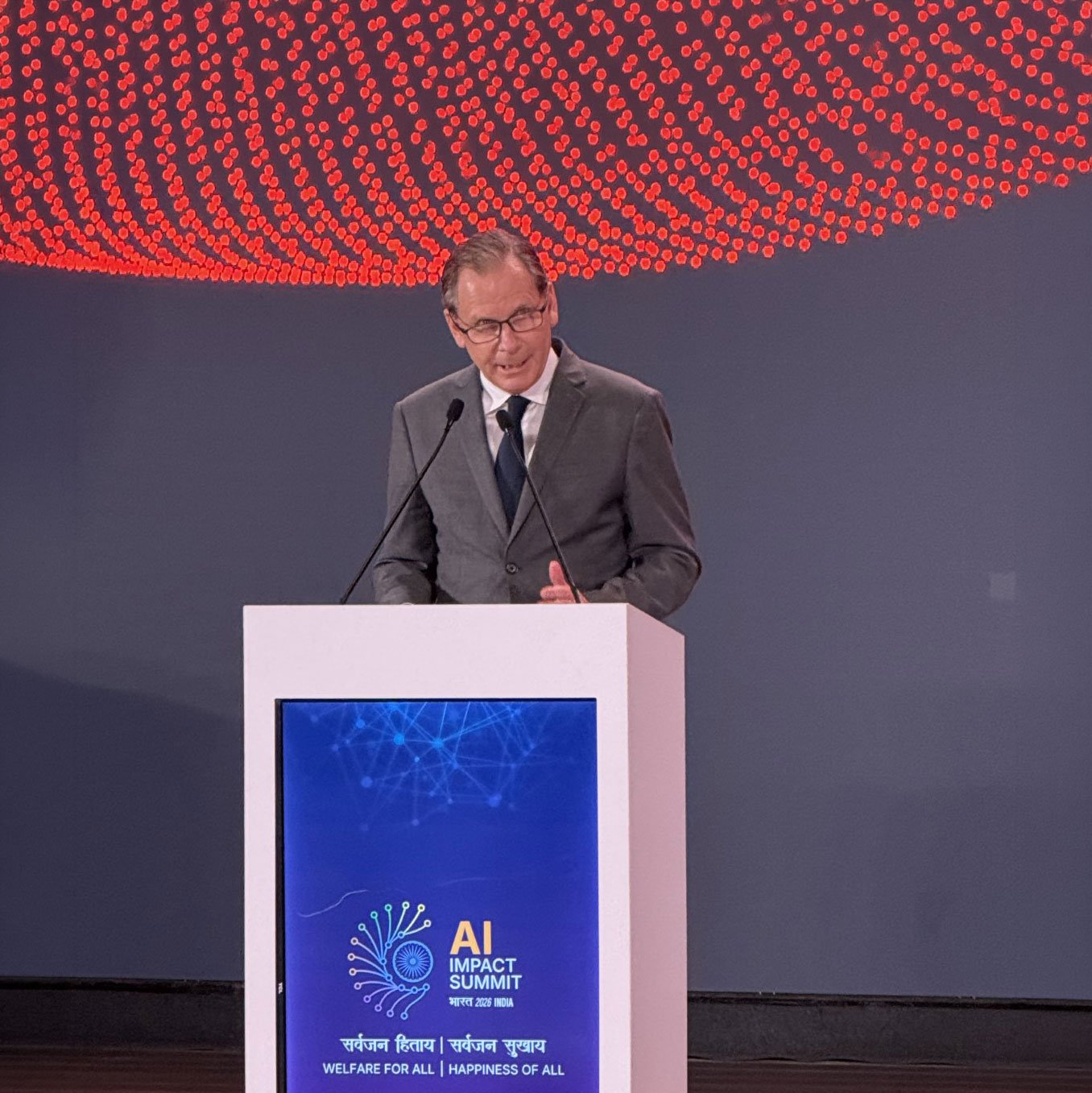
Kyndryl Chairman and Chief Executive Officer Martin Schroeter delivered a keynote at the India AI Summit on February 19, 2026.
Because when AI moves from labs into the systems that power economies, governments, hospitals, banks, transportation networks and energy grids, getting it wrong is not an inconvenience — it impacts lives.
These systems sit at the heart of what this Summit represents: People, Planet and Progress. And progress in all three depends on the ability to operationalize AI — reliably, and at scale.
So, today, I’ll share a bit about what we’re learning working with our global customers and partners to close the gap between intelligence and reality — and where AI either becomes part of how work actually gets done and industries operate, or never makes it out of experimentation.
What we’re seeing globally is not an innovation problem — it’s a readiness problem.
Kyndryl conducted a global study with business and IT leaders, and our research showed that while more than two-thirds of global organizations are heavily investing in AI, almost half still struggle to see meaningful returns. And in India, 75% said their innovation efforts stall after the proof-of-concept stage.
We get ready by focusing on the fundamentals: infrastructure that can scale, security that earns trust, and people with the skills to operate AI responsibly.
So based on our research and experience with customers — many in regulated industries — the leading indicator for why AI projects stall is not because the technology isn’t smart. It’s because we haven’t industrialized AI yet. The infrastructure, data, operations and people simply aren’t ready to support AI adoption and deployment at scale.
Our customers want greater clarity and support on four critical questions:
First, on operational conduct. They want to know how to deploy AI when data is fragmented across clouds, core systems and the edge; when business processes were never designed for AI; when regulations differ by sector and geography; and when trust, security and resilience are imperative to how it works.
Second, more systemically, they’re asking:
Third, they’re asking about agentic AI — whether they’re truly ready to use it in mission-critical environments. Are they able to meet regulatory requirements? Are they able to integrate with existing systems?
Fourth, they’re asking about their workforce — how to prepare people for new ways of working with AI. Nine in 10 leaders expect AI to fundamentally reshape work, yet fewer than one in three believe their workforce is ready, or that they’re equipped to help their teams get there.
All of this ultimately ladders up to trust. Can leaders trust these AI systems and the insights they provide? That trust is built when AI operates within clear guardrails — where actions are accountable, transparent and explainable — which is essential for organizations in every industry, and especially in government, banking and other regulated environments.
These are the core readiness challenges we see — and they’re at the heart of why so many AI initiatives stall. They remind us that innovation must operate reliably, predictably and securely, day after day, in the real world.
So, I’m thrilled that this year’s AI Summit is in India because India is one of the world’s most important proving grounds for industrializing AI at extraordinary scale.
Innovation must operate reliably, predictably and securely, day after day, in the real world.
Under the leadership of Prime Minister Modi, India has recognized AI as a strategic national priority — building the policy, digital and talent foundations needed to support innovation at scale. Through initiatives like Digital India, the IndiaAI Mission, and investments in digital public infrastructure, India has positioned itself not just as an adopter of AI, but as a global contributor to how AI can be deployed responsibly and inclusively.
AI-powered platforms like the Unified Lending Interface are expanding access to credit at scale — reducing loan processing times from weeks to minutes — while improving transparency and inclusion.
India’s digital experience offers an important lesson for the world: when technology must operate at national scale — across public services, financial systems, healthcare, transportation and energy — reliability, governance and human integration are not features — they are prerequisites.
Kyndryl is very proud to be a partner to many of India’s leading companies and government agencies.
We are deeply committed to helping India, and partners around the world, implement AI at this scale to drive People, Planet and Progress outcomes.
In every part of the globe, the conversation about agentic AI must now shift from intelligence to industrialization — from what AI can do to how it is orchestrated, governed, secured, integrated and sustained, with agents and humans partnering to drive business impact.
This is a transition every major technology and invention has gone through. Invention comes first. Impact comes when societies learn how to industrialize it — safely, reliably, and at scale.
Progress depends on the ability to operationalize AI reliably, and at scale.
A critical part of this industrialization is operationalizing AI governance. That means moving governance out of policy documents and into live systems — embedding auditability, logging, explainability and compliance directly into how AI operates. We’re seeing how our approaches like policy as code can establish clear guardrails for agentic AI to drive trust and compliance, giving regulators, boards and citizens confidence that these systems are controlled, accountable, and safe.
So, what do we do next?
We get ready by focusing on the fundamentals: infrastructure that can scale, security that earns trust, and people with the skills to operate AI responsibly.
This readiness perspective is particularly important for policymakers. Because the impact of AI will not be measured only by productivity gains or economic growth — important as those are to drive the future. It will also be measured by how institutions help people adapt in this next phase of industrial automation and how work evolves.
The future of AI will not belong to a single platform, model or geography. It will be multi-cloud, multi-model and hybrid by default. It’s a transformation of work, skills and operating models. And as AI scales, its environmental footprint becomes an operational issue as well — making efficiency, resilience and sustainability part of responsible AI by design. Therefore, collaboration across governments, enterprises, and technology partners will be essential.
AI can absolutely change the world. It can change work, skills, mindsets and operating models. But it will only change the world when it is embedded — responsibly and reliably — into the systems that societies depend on every day.
The future of AI will not be decided in research labs or boardrooms. It will be decided by the choices and investments we make now — by how we close the gap between experimentation and industrialization.
The work ahead is hard. Because this is not just a technology shift — it’s a human shift.
We have to build trust in AI. We have to reskill our workforces at scale. And we have to ensure that these systems are worthy of the societies that depend on them.
This responsibility belongs to companies and governments alike.
And it is a responsibility worth embracing. Because when AI is industrialized responsibly, it doesn’t just optimize systems — it strengthens the institutions people rely on every day.
That is how AI truly changes the world.
Thank you.

