


Leading thinkers Ismail Amla, Aidan McCullan, Alex Osterwalder, Rita McGrath and Usman Sheikh discuss how AI is driving new business models.
In this first of a kind collaboration, The Innovation Show x The Kyndryl Institute podcast brings together five leading thinkers and innovators who are on the front line working with the world’s largest companies as they navigate how AI is evolving current business models. Thinkers50 award winner Aidan McCullan hosts the podcast and is joined by Ismail Amla, Senior Vice President of Kyndryl Consult, Alex Osterwalder, co-founder and CEO of Strategyzer, Rita McGrath, author, professor, and innovation and growth expert, and Usman Sheikh, Managing Director of High Output Ventures. The conversation explores how AI is creating new business models by fundamentally reshaping organisations – from technology, to leadership, and how value is created.
Ismail Amla frames AI as a shift from “bolting on technology” to rewiring the enterprise. He argues that organizations must rethink decision‑making, governance, and accountability as humans increasingly become “meaning makers” as human/AI collaboration progresses. The real challenge lies in aligning workflows, auditability, and ethics with strategic intent, particularly in regulated environments– as well as reimagining what an AI-native enterprise looks like.
Alex Osterwalder emphasises that AI challenges core business models, not just products or processes. He highlights the return of the entrepreneurial CEO—leaders who work directly with customers to understand how AI reshapes value propositions. Alex stresses that fundamentals such as customers, value creation, and value capture remain constant, but their content is changing fast, which he argues presents the imperative for organisations to run portfolios of experiments rather than betting on a single strategy.
Rita McGrath situates AI within a broader historical transition away from mass‑production hierarchies toward permissionless, mission‑driven organisations. She underscores the decline of the billable hour, the rise of outcome‑based value, and the redistribution of power to the organisational edges. Her key insight is that AI is forcing companies to unlearn legacy practices and accept temporary advantage as the new norm.
Usman Sheikh focuses on the structural bottlenecks AI expose. He warns that accelerating production without changing permission, pricing, and review mechanisms creates friction rather than value. Usman argues that firms must decouple growth from headcount by encoding learning into systems, shifting incentives, and redesigning how outcomes—not activity—are measured and rewarded.
Collectively, the panel agrees: AI rewards organisations willing to rethink power, pricing, leadership, and those willing to face what needs to be unlearned. Watch the full podcast to understand how.
Key highlights
- Alex - ‘So it's not enough to manage what you have anymore. You really need to get into the trenches. So I think it's this revival of the entrepreneurial CEO, almost Steve Jobs style, maybe not with the same kind of aura, but definitely that kind of working where CEOs are becoming product people again.’ (00:05:47:07)
- Aidan - ‘I can use these technologies like AI, I can use agents to do my work faster, but then it has to go to a layer where I don't have the permission to actually act. And we've seen that some people got caught up from that badly, which has scared a lot of organizations, but this idea of overly tracking people or not giving them the permission to actually go and ship their work is a huge constraint.’ (00:14:30:23)
- Ismail - ‘This technology is amazing, it's easy to set up, agents are almost free to create, the magic is in the workflow. But if you've now got hundreds of thousands of agents, autonomous, working in your production environment, and you're in a regulated industry, how can you go back and have an audit trial and say, actually, not only are they behaving as they're asking them to behave, but they're behaving as our organization, mission and purpose, needs them to behave.’
(00:19:48:07)
- Usman - ‘We have to start measuring how the work is changing, how the pricing structure is changing. Because if you are just simply tacking this on and saying utilization of AI tools has gone up without the invoice changing or without the delivery mechanism changing, then it's short lived.’
(00:22:39:11) - Rita - ‘I think we're in this moment with AI where you have to write off an awful lot of stuff that you've learned to do. You have to depreciate a lot of existing assets. You have to unlearn a lot of painfully gained tacit knowledge. I mean, there's just all this stuff that you have to segue into the past in order to capture the productive capacity of what's to come. And I think we're in that moment where a lot of organizations, they won't tell you this, but they're deeply afraid of having to admit how much is tied up in these legacy systems.’
(00:26:07:18)
Meet the collaborators

Aidan McCullan
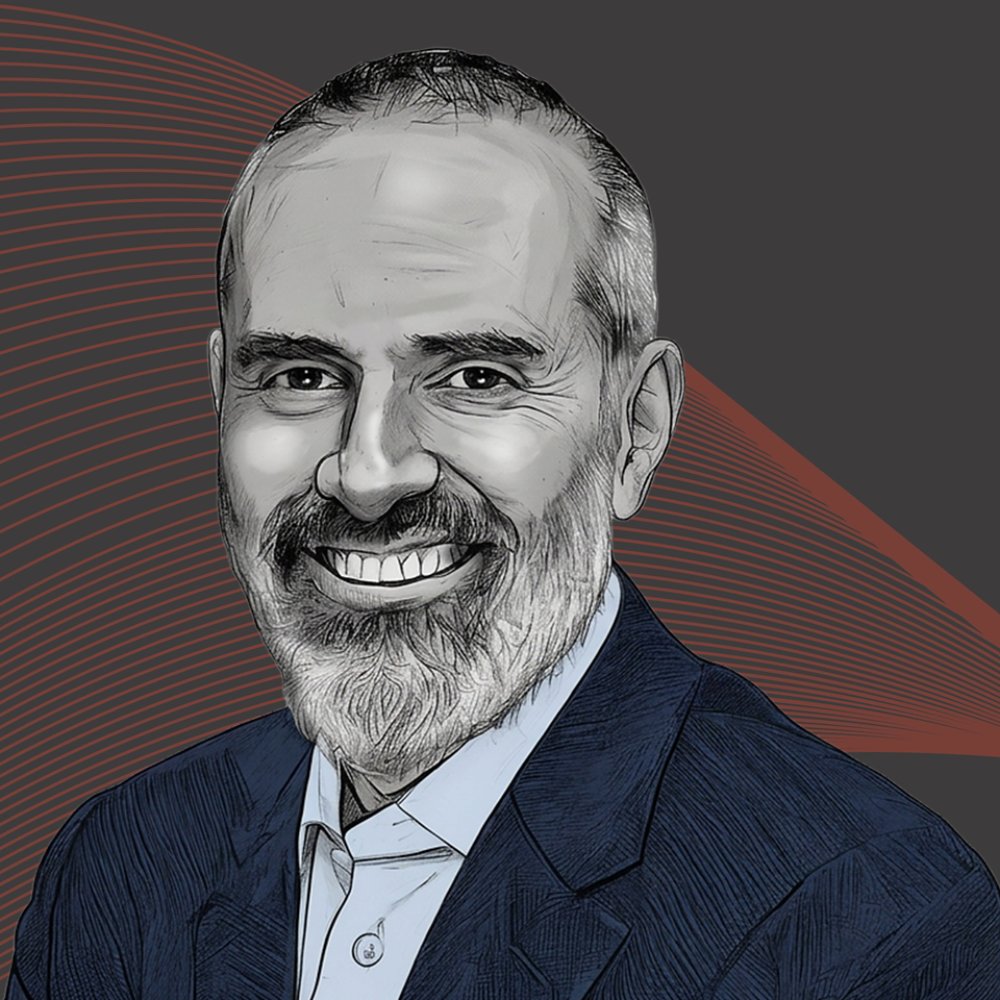
Ismail Amla

Dr. Alex Osterwalder

Rita McGrath, Ph.D,

Usman Sheikh
Have questions or want to learn more?